Ecommerce link building that lifts the pages that sell
Category pages target the broad terms shoppers search, yet they rarely earn links on their own. We build backlinks that point authority straight at them.
Ecommerce link building sends authority to the pages that generate revenue: collections, categories and your strongest product pages. We place contextual links on relevant blogs and in existing articles that point to those pages. That lifts them for the commercial searches your shoppers make.
Online stores often see their blog collect the odd link while their money pages sit on page two. We change that balance with placements that read naturally and carry guaranteed metrics.
Category pages first
We prioritize collection and category URLs because they rank for the broad terms shoppers search.
Product relevant hosts
Placements on lifestyle, home, hobby and industry blogs that match what you sell.
Safe anchor mix
Branded and descriptive anchors keep your store's profile natural as volume grows.
Why do ecommerce sites struggle to earn links?
Ecommerce sites struggle to earn links because publishers link to helpful information, not to a grid of products and prices. The result is a lopsided profile. The homepage and blog posts hold the links, while the category pages that ought to rank hold almost none.
Link building for ecommerce fixes this by creating context. A guest post about choosing hiking boots links naturally to your hiking boots category. A niche edit in an existing gift guide links to a product line. The reader gets value, and your commercial page gets authority.
Which ecommerce backlinks suit which store pages?
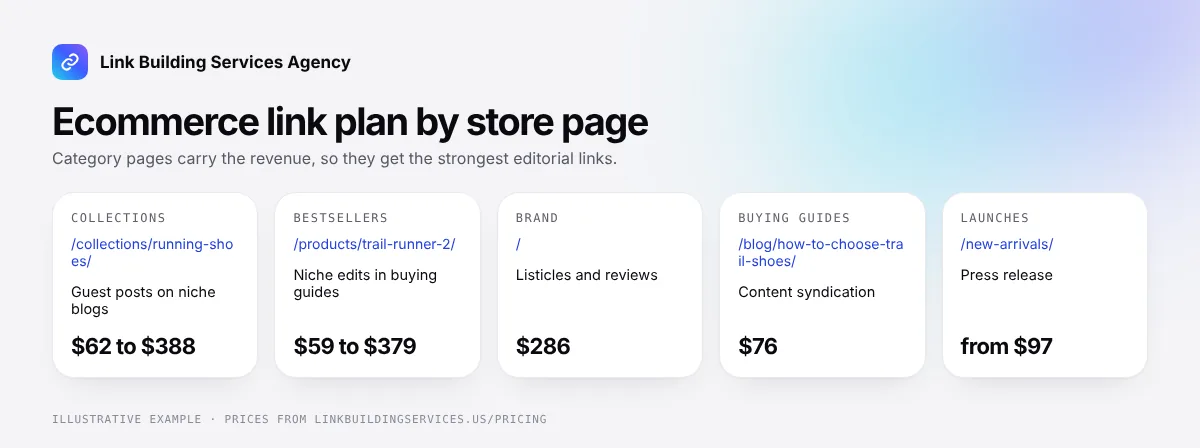
Category pages suit guest posts, bestselling products suit niche edits and the homepage suits brand mentions. This table shows how we match our services to the structure of an online store.
| Store page | Recommended link type | Price |
|---|---|---|
| Category and collection pages | Guest posts on niche blogs | $62 (DR 10+) to $388 (DR 60+) |
| Bestselling product pages | Niche edits in buying guides | $59 (DR 10+) to $379 (DR 60+) |
| Homepage and brand | Brand listicles and reviews | $286 per placement |
| Buying guides on your blog | Content syndication | $76 per campaign |
| Product launches | Press release distribution | From $97 |
Prefer a done for you mix? Our link building packages start at $510 for 5 backlinks with an account manager.
What does a first month of ecommerce link building cost?
A first month covering 3 category pages costs $770, or $693 with the 10% monthly subscription. This worked example uses only our published prices.
| Target | Links | Unit price | Subtotal |
|---|---|---|---|
| Category page A | 2 DR 30+ guest posts | $102 | $204 |
| Category page B | 2 DR 30+ guest posts | $102 | $204 |
| Category page C | 2 DR 30+ guest posts | $102 | $204 |
| 2 bestselling products | 2 DR 20+ niche edits | $79 | $158 |
| Total | 8 links | $770 |
Month 2 shifts links toward the categories that moved most. Our link building cost calculator runs the same math for your own store.
How does our ecommerce link building process work?
Our ecommerce link building process works in 5 steps, with links live within about 14 days.
- Revenue mapping: we identify the categories and products that earn the most and sit closest to page one.
- Topic angles: we plan guides, comparisons and how to articles that make each link useful.
- Prospecting: we find blogs your customers read and check each for organic traffic and spam signals.
- Writing and placement: native English writers produce the content and we secure the links.
- Reporting: you receive each live URL with its metrics, ready to compare against category rankings.
When do you build links for seasonal categories?
We build links for seasonal categories at least 3 months before peak demand. Search engines take time to crawl new links and reassess rankings. Links built in the final weeks before a holiday or summer peak arrive too late.
New product lines follow the same logic. Pair a press release announcing the launch with 2 to 4 guest posts pointing at the new category. The release builds brand signals while the guest posts deliver lasting authority.
Who is our ecommerce service for?
Our ecommerce service suits 4 types of store and agency.
- Shopify, WooCommerce and BigCommerce stores with good products but weak category rankings.
- Direct to consumer brands competing against marketplaces and larger retailers.
- Ecommerce agencies that want dependable link fulfilment for store clients.
- Stores expanding abroad, which add multilingual outreach for Spanish, French and Italian markets.
We do not accept stores selling alcohol, gambling products, adult items or other restricted categories.
How do you get the most from every ecommerce backlink?
You get the most from every ecommerce backlink by pointing it at a category page that deserves to rank. Give each target category a short, helpful introduction, internal links to subcategories and a fast loading product grid. Our on page SEO guide covers the basics.
Thin category pages with only a product grid give search engines little text to understand. Two or three well written paragraphs often change that.
Judge ecommerce link building by category rankings, organic sessions to those categories and the revenue they generate. Raw link counts tell you little. Track each target page before and after a campaign to see which collections respond and where the next round of links belongs.
See how an order works
From order to live link in four steps. You get an email update at each step and an unbranded report at the end.
Related guides
What Are Backlinks? Definition, Types and Value
What are backlinks? Links from other sites to yours. The 7 types of backlinks, what makes one valuable or risky, how to earn them and what each costs.
On Page SEO: A Practical Checklist for Pages That Rank
A practical on page SEO checklist covering intent, titles, headings, content, internal links, images and schema. Fix what holds your pages back today.
How to Do Keyword Research for SEO: A 5 Step Guide
Learn how to do keyword research the practical way: find seed terms, judge intent and difficulty, cluster keywords and map them to pages that can rank.
Ecommerce link building questions
Do ecommerce links point to product pages or category pages?
Mostly category pages. They target broader, higher volume searches and stay live for years, while products sell out or get discontinued. Strong category pages also pass authority down to the products they list. We point a smaller share of links at bestselling products with steady, long lasting demand.
How many backlinks does an online store need?
The right volume depends on your niche and the strength of competing stores. Start by comparing the referring domains of stores ranking for your main category terms. Smaller shops often start with 5 to 10 links a month, then add volume for the categories that respond best.
Do publishers link directly to a shop page?
Yes, publishers link to a shop page when the link adds value to the article. A post about setting up a home office links naturally to a category of ergonomic chairs. We plan topics so the link makes sense to the reader. That is why editors accept our placements and they tend to stay live.
Can you build links for stores outside the US?
Yes, our English placements suit stores selling in the US, UK, Canada and Australia. For Spanish, French and Italian speaking markets, our multilingual outreach places native language articles on local publishers. Prices run from $204 to $561 per placement, with outreach handled by native speakers.
Do you work with Shopify stores?
Yes, the platform makes no difference to link building, because we only need your target URLs and preferred anchors. Shopify, WooCommerce, BigCommerce, Magento and custom stores all work. Tell us before a redesign that changes category URLs, so links point to the final versions.
Start building links in minutes
Place your first order in minutes. We email you at every stage and send an unbranded report when links go live. No contracts, no minimums.