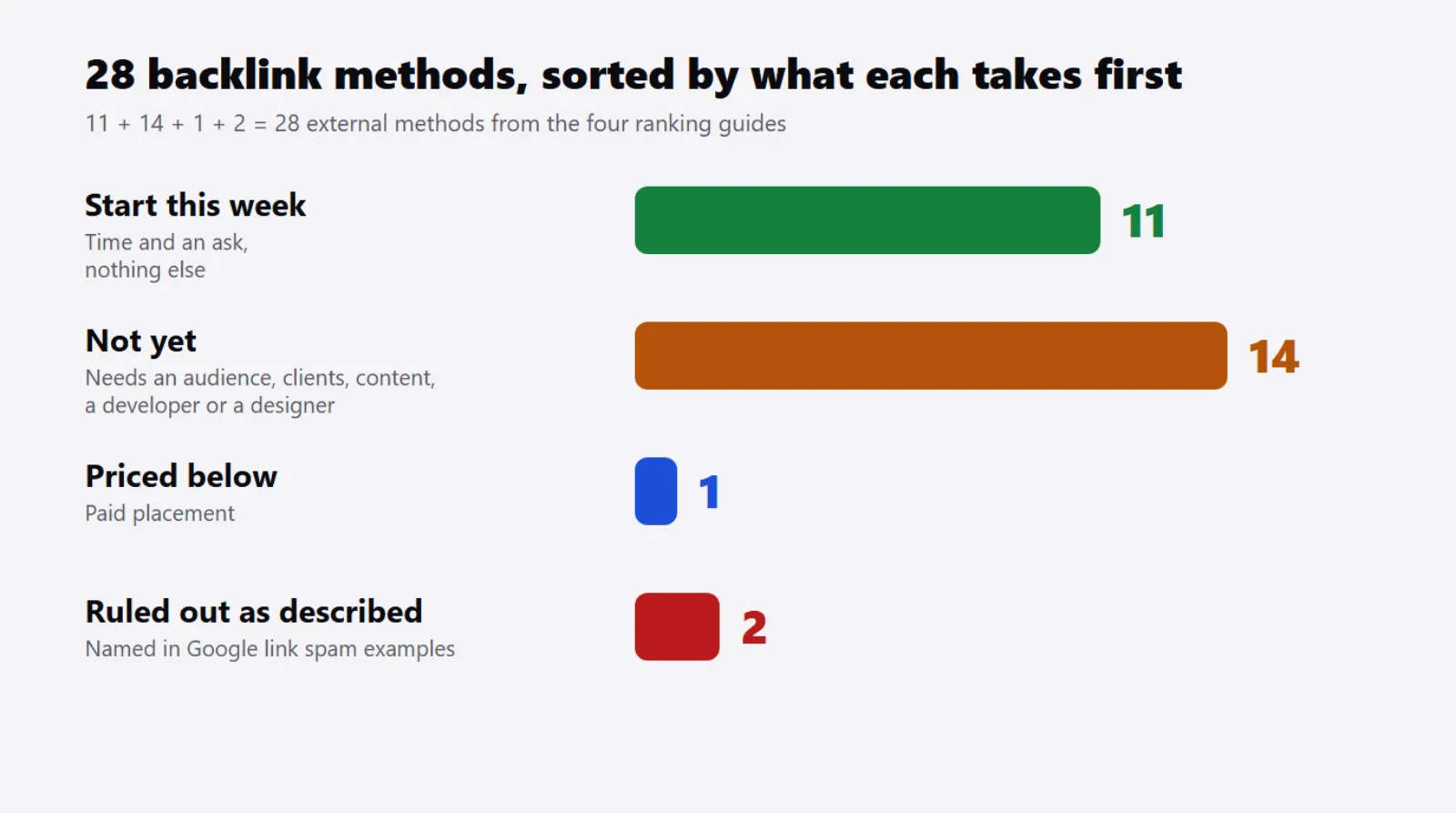
You have a site, one page you are trying to rank, and every result above you carries hundreds of referring domains. Here is how to get backlinks with no audience and no budget. Of the 28 methods the top ranking guides recommend, 11 need nothing but a real business and your own hours.
Fifteen of the other 17 wait on an audience, past clients, existing content, a developer or money. The last two sit inside Google's own link spam examples, alongside the link exchange that a third guide recommends in its body copy.
We sort every method by the one thing it requires, show you three of them as real requests, and price your own hours against a link we place for you.
Want them placed instead of pitched? Our SEO link building services start at $59 a link, with a 1 year replacement if a link is lost.
- 11 of the 28 methods the top ranking guides recommend run on a site with no audience, no clients, no data and no budget.
- 8 of the 10 coverage checks score zero across the four guides that rank with you for this question. Two of those zeros: what a new site does first, and how to tell whether a link counted.
- Those four guides print 43 tactics and agree on none of them: 76% of the distinct items appear on one page only.
- 94% of blog posts earn zero external links, so the page you pitch answers something better than whatever ranks for it now.
- A DR 10+ placement costs $62, or 1.6 hours at the US median marketing wage. A free method that takes longer than about two hours a link costs more than buying one.
How to get backlinks right now: which methods can you run, and which need something you do not have?
11 of the 28 methods the top ranking guides recommend run on a site with no audience, no clients, no data and no budget. Every method those guides print is here, with the one thing it takes before it works and a verdict for a site with no links yet.
The four guides that rank with you for this question print 43 tactic labels between them. Collapse the duplicates and 33 distinct items remain. Four of those describe a state rather than an act, and one is internal linking, which leaves 28 external methods.
Swipe sideways to see every column →
| Method | What it takes first | Named by | Verdict for a new site |
|---|---|---|---|
| Journalist and expert quote requests | Time, and a real expert to quote | HubSpot, The HOTH | Start this week |
| Direct journalist pitching | Time | HubSpot | Start this week |
| Dead link replacement | Time, and one page worth linking to | HubSpot, The HOTH, SpyFu | Start this week |
| Guest posts pitched on merit | Time, and one writeable idea | HubSpot, The HOTH, DMI | Start this week |
| Contextual link requests on pages that already exist | Time | HubSpot | Start this week |
| Resource page listings | Time, and one page worth listing | SpyFu | Start this week |
| Link roundups | Time | SpyFu | Start this week |
| Networking online and publishing your own round ups | Time | DMI | Start this week, with the reciprocity limit below |
| Competitor backlink mining | Time, and a free backlink checker | SpyFu | Start this week. Produces prospects, not links |
| Interviews and podcast appearances | Time | DMI | Start this week |
| Giving testimonials | Time, and a product you actually use | SpyFu | Start this week |
| Unlinked brand mention reclamation | Pages that already name you | HubSpot | Not yet |
| Inclusion in a best of list | A product people already list | HubSpot | Not yet |
| Asking your social followers | A following | SpyFu | Not yet |
| Facebook closed groups | A following. The page recommending it warns it can get you banned | SpyFu | Not yet |
| Influencer marketing | A following or a budget | SpyFu | Not yet |
| Asking current clients and subscribers | Past clients or subscribers | SpyFu | Not yet |
| Publishing case studies | A client result you are free to publish | SpyFu | Not yet |
| Collaborating on a project with someone else | A collaborator | DMI | Not yet |
| Updating existing content | Content that already exists | HubSpot | Not yet |
| Building a free tool | A developer | HubSpot, The HOTH | Not yet |
| Publishing an ultimate guide | Weeks of writing | HubSpot, The HOTH | Not yet |
| Images and infographics | A designer or a dataset | HubSpot, The HOTH, DMI | Not yet |
| In depth link worthy content | Weeks of writing | DMI, SpyFu | Not yet |
| Letting others credit and reuse your work | Something worth reusing | DMI | Not yet |
| Niche edits and link insertions | Money. Ours from $59 | HubSpot, The HOTH | Priced below |
| Directory submissions | Nothing, and Google's spam examples name low quality directory links | HubSpot | Ruled out as described |
| Blog comment links | Nothing, and Google's spam examples name comment links | SpyFu | Ruled out as described |
Four labels in those lists are not methods at all. One says stick to your niche, one says get creative, one says raise your site's credibility, and one says link building rests on relationships with the right people. Each describes a condition rather than an act, so a beginner counting nine practices on one of those pages is really handed six or seven things to do.
The six rows that wait on a developer, a designer or a dataset are the linkable asset group: free tools, ultimate guides, infographics and original research. They earn links on their own once they exist, which is why every guide recommends them and why none of them starts on a Monday morning.
Money buys exactly one row outright. Everything else in the start this week group costs hours and an ask, which is what the rest of this page covers. For the work itself and how a campaign runs, see what link building is.
How many of the methods the top guides recommend work for a site with no audience?
None of them, on the pages that currently rank. Across the four guides that rank with you for this question, 0 of 4 say what a site with no audience does first. The same 0 of 4 give you a way to tell whether a link counted.
We scored all four on ten checks a beginner cares about. 8 of the 10 score zero across all four of them.
Swipe sideways to see every column →
| Check | HubSpot | The HOTH | DMI | SpyFu | Score |
|---|---|---|---|---|---|
| Names Google's link spam policy or any Google policy document | no | no | no | no | 0 of 4 |
| Explains rel sponsored, rel nofollow or rel ugc | no | no | no | no | 0 of 4 |
| Gives a way to verify a link is live, followed and indexed | no | no | no | no | 0 of 4 |
| States how long a backlink takes to affect rankings | no | no | no | no | 0 of 4 |
| Says what a site with no audience does first | no | no | no | no | 0 of 4 |
| States any cost, per link or per hour | no | no | no | no | 0 of 4 |
| Visible FAQ block | no | no | no | no | 0 of 4 |
| Named author with a visible bio or credentials | yes | no | no | no | 1 of 4 |
| Separate reviewer | no | no | no | no | 0 of 4 |
| A real last updated date, with month and day | yes | no | no | no | 1 of 4 |
The agreement between them is thinner still. Four pages ranking for the same question print 43 tactics and agree on none of them. 0 items are named by all four. 25 of the 33 distinct items, which is 76%, appear on one page only. Three items reach three of four: dead link replacement, guest posts pitched on merit, and images and infographics.
So the counts in their titles, 14, 14, 9 and 6, are not competing method sets. They are four writers listing what came to mind. The useful thing is not a fifteenth list, it is a rule for deciding which of the 28 apply to you.
What does your page need before anyone links to it?
94% of blog posts carry zero external links, so the page you pitch stands apart from almost everything published. Backlinko measured 912 million blog posts with data partner BuzzSumo and published that figure in February 2019. The same study found that only 2.2% of content earns links from more than one site.
Three things make a page askable, and all three are inside your control today.
- One page that answers a question better than whatever ranks for it now. Open the current top three results and name the thing they leave out. That gap is your pitch.
- One reason a stranger gains by linking. An editor links to protect their own reader, never to help you. A dead link replaced, a number their page is missing, a definition they keep retyping.
- A working contact route. A named sender, a reply address that a human reads, and an about page that proves a real business sits behind the request.
Every method carries one prerequisite. Answer six questions about yourself and the list sorts itself.
Swipe sideways to see every column →
| Question about you | What a yes adds | Methods |
|---|---|---|
| Do you have a site and some hours? | The start this week group | 11 |
| Does any page already name your brand without linking? | Unlinked mentions and best of lists | plus 2 |
| Do you have an audience anywhere? | Social asks, groups, influencer work | plus 3 |
| Would a past client, supplier or collaborator vouch for you in public? | Client asks, case studies, collaborations | plus 3 |
| Do you have existing content, a developer, a designer or a dataset? | Updates, tools, guides, images, deep content, reuse terms | plus 6 |
| Do you have a budget for one link? | Paid placement, ours from $59 | plus 1 |
A reader who answers no to all six still has 11 of the 28 methods, which is 39% of everything the top ranking guides recommend. That is the number to start from this week.
Where do you find the pages that already link to sites like yours?
Two routes produce prospects: a backlink checker pointed at a competitor, and search operators. Both hand you pages, not links. The link comes from the ask in the next two sections.
Point a free backlink checker at the page outranking you and read its referring domains. A site that already links to the page beating you has proved it links to pages like yours. The free tiers of the checkers these guides name return the top backlinks and anchors on any domain, which is enough for a first list of 50 prospects.
Search operators find the pages built to link out. Paste these into Google with your own topic in place of the quoted phrase.
- intitle:"link roundup" your topic finds weekly and monthly round ups that exist to link out.
- inurl:resources your topic finds curated resource pages.
- inurl:links your topic finds the older style link library, common on university and association sites.
- "recommended tools" your topic finds list pages that already name products in your category.
- "write for us" your topic finds the sites that publish outside contributors on purpose.
Vet every prospect before you spend an email on it. We run four checks on every site before we place a link on it, and they work the same on your own list.
- Traffic trend. Organic traffic flat or rising, not a graph that fell off a cliff last spring.
- Outbound link ratio. A page stuffed with outbound links to unrelated niches is selling, not publishing.
- Topical fit. The site covers your subject already, in its own voice.
- Spam signals. Thin posts, scraped text, casino or adult outbound links, no named humans anywhere.
How do you get backlinks from a journalist, a dead link and a resource page?
Three methods carry a new site: a journalist request, a dead link replacement and a resource page listing. Each one is a single email with a clear reason attached, and each one has a visible proof that it landed.
Getting a backlink from a journalist request
Journalist request platforms publish what reporters are writing this week and what expertise they want. Qwoted, Featured and Source of Sources run the queries that the original HARO audience moved to. Registration is free and the inbox fills daily.
A usable answer is short. One claim stated plainly, one reason it is true, one example or number from your own work, and a single line on who you are. Send it inside the stated deadline, because a reporter on a Thursday deadline reads Wednesday answers.
HubSpot's author reports her own experience: 2 of every 10 answers selected, about four weeks from send to publication.
What proves it landed: your name and a link appear in the published article, the link survives in the page source, and the URL is indexed.
Our HARO link building runs the same play for you: 3 journalist links for $549, which is $183 a link. Those land on DR 50+ publications in 30 to 45 days.
Getting a backlink by replacing a dead one
Find a guide in your topic that links out often, then run a free broken link checker across it. The Check My Links extension flags dead URLs in the browser, and Screaming Frog's free tier reports every 404 it crawls.
The offer writes itself once a dead link appears. Name the broken URL, say what it used to cover, and point at the page of yours that covers the same ground now. An editor fixing a 404 is protecting their own page, which is why this method clears a higher bar than a cold guest pitch.
What proves it landed: the replacement URL sits in the live HTML of that page and carries no rel nofollow value.
Getting listed on a resource page or a round up
The operators in the previous section find the lists. A curator takes three things: a page that fits a category the list already uses, a pasteable one line description, and a URL that loads fast.
The ask is one line. Name the list, name the category inside it, give the link and the single line description, and stop. No pitch about your mission, no attachment.
What proves it landed: your entry renders in the list, the link is followed, and the page is in Google's index.
What do you put in the message that asks for the link?
Three things go in the message: the exact page you want linked, the exact reason it helps their reader, and nothing else. Every sentence after those two is a reason to delete the email.
Here is the shape, at the level of the ask itself.
- Line 1, the page. "Your guide to X links to Y in paragraph four, and that URL now returns a 404."
- Line 2, the reason. "We published a replacement that covers the same benchmark data, updated this year."
- Line 3, the link. One URL on its own line.
- Line 4, the sign off. Your name, your role, your site. No signature block with six social icons.
Write the reason in their reader's interest, not yours. "It would help our SEO" is true and it is the one sentence that ends the conversation. "Your readers hit a dead page in step four" is also true and it gets a reply.
The prospect list, the editor address hunt, the template, the follow up timing and the email rules all belong to blogger outreach.
Which of these methods does Google's link spam policy rule out?
Three of them: low quality directory links, blog and forum comment links, and link exchanges. All three appear in Google's spam policies as link spam examples. Three of the four guides ranking for this question recommend one of them, and none names the policy.
Swipe sideways to see every column →
| Practice | What Google's link spam examples name | Which guide recommends it |
|---|---|---|
| Low quality directory submissions | Low quality directory or bookmark site links | HubSpot, tactic 11 |
| Blog and forum comment links | Forum comments with optimized links in the post or signature | SpyFu, tactic 14 |
| Link exchanges | Excessive link exchanges, in Google's words "Link to me and I'll link to you" | DMI, practice 5, which tells readers to agree swaps with professional contacts |
Google defines link spam as creating links to or from a site primarily for the purpose of manipulating search rankings, and states that sites violating its policies may rank lower in results or not appear in results at all.
Comment links fail twice over. Google recommends marking user generated content links, such as comments and forum posts, with the ugc value. Links carrying these rel values are generally not followed, so the link sits there for years and passes nothing.
Automated programs or services that create links to your site sit in the same list of examples. That is the real answer to every search for a fast route.
One more line in that list reaches a new store before anything else does. Google names sending someone a product in exchange for them writing about it and including a link. The review is yours to ask for, the followed link is not.
Paid placement is treated differently. Google says it is not a violation to have such links as long as they are qualified with rel sponsored or nofollow. A qualified link passes no ranking credit. The detection, the penalties and the recovery path are covered in black hat link building.
How many backlinks does a new site need, and where does the 20 to 30 number come from?
No sourced number exists, and the one figure these guides repeat has no study behind it. One guide prints 20 to 30 backlinks with no attribution at all. HubSpot prints the same range and credits the specialists at a link building vendor, which is a claim rather than research.
The one measured answer in this subject is relative. Ahrefs studied 10,000 non branded keywords and the top 20 US pages for each, 200,000 pages in all. It reported in September 2018 on the pace at which number one ranking pages gain followed backlinks from new referring domains. For most of them that pace runs between 5% and 14.5% a month. The same backlink growth study adds that it can neither support nor disprove the idea that pages gain links because they rank.
That is a growth rate against a page's own profile. A page with 20 referring domains and a page with 500 are described by the same percentage and sit a hundred links apart.
So the checkable target is not a number from a blog post. It is the referring domain count of the three pages you are trying to pass, and the pace at which they add new ones. Both are visible in any backlink checker, both move, and both are specific to your keyword.
When is paying for a link cheaper than earning one?
A guest post on a DR 10+ site costs $62, which is 1.6 hours of your own time at the published US median wage for a marketing specialist. The US Bureau of Labor Statistics puts that median at $37.87 an hour in its May 2025 survey. Any free method that takes you longer than about two hours a link has already cost more than buying the link.
Swipe sideways to see every column →
| What you buy instead | Price | Per link | Hours of your own time at $37.87 |
|---|---|---|---|
| A niche edit on a DR 10+ site | $59 | $59.00 | 1.6 |
| A guest post on a DR 10+ site | $62 | $62.00 | 1.6 |
| A guest post on a DR 30+ site | $102 | $102.00 | 2.7 |
| The Starter package, 5 links | $510 | $102.00 | 2.7 |
| The Growth package, 10 links | $1,020 | $102.00 | 2.7 |
| Journalist links, pack of 3 | $549 | $183.00 | 4.8 |
| A guest post on a DR 60+ site | $388 | $388.00 | 10.2 |
The trade runs both ways, and the free side wins more often than a price list suggests. A founder with spare hours and no budget runs the 11 startable methods, keeps the money, and learns which editors answer.
Paying wins on pace and on tiers you cannot reach cold. A DR 50+ publication rarely answers a first time pitch, and a campaign due to produce 10 links this quarter cannot wait on reply rates.
Our terms on a placed link: DR is guaranteed at the moment the link goes live, Ahrefs traffic from DR 30+, with a 14 day claim window. A lost link is replaced for 1 year from the delivery date, on a site of the same tier or higher, at no extra fee.
Google's spam policies treat links bought to pass ranking credit as link spam, and we say so on every page where we sell one. Full link building pricing lists every DR tier, package and turnaround.
Frequently asked questions
How long does it take to get your first backlink?
We deliver a typical placement in 14 days and a journalist pack in 30 to 45 days. A pitch you send yourself lands whenever an editor answers, which sits outside your control. Ranking movement starts later again, after Google recrawls the page now carrying your link. Treat the first month as prospecting rather than results.
Do you need a blog before you can get backlinks?
No. A journalist quote, a resource page listing and a testimonial link all point at a home page or a service page. A blog helps with dead link replacement and guest pitches, because both ask an editor to link to something worth reading. One strong page beats an empty blog.
Can you get backlinks without doing any outreach?
Two ways only: publish something people find and cite on their own, which is the slowest route on this page, or pay for placement. Every other method here is an ask. With 94% of blog posts earning zero external links, waiting is the default outcome rather than a plan.
How many requests does it take to get one backlink?
Nobody publishes a sourced reply rate for cold outreach. The one practitioner figure on this subject is HubSpot's author reporting her own: 2 of every 10 journalist answers selected. Log your sends and replies from week one and you own a real rate inside a month.
Does leaving your link in blog comments still work?
No. Google's link spam examples name forum comments with optimized links in the post or signature, and Google recommends the ugc value on user generated content links. Links carrying that value are generally not followed. The tactic still appears on a guide ranking in the top 5 for this question.