Google allows a paid link when it carries rel="sponsored" or rel="nofollow". A paid link that passes ranking credit is link spam under Google's own policy. That covers every paid dofollow placement, including the ones we sell. The answer has those two halves, and most sellers print only one of them.
Both halves are below: Google's own words on paid links, the market average for a bought link across nine Domain Rating bands from a dataset of 62,916 sites, the four spam updates Google shipped in 2026 with their dates and durations, and a test you run on your own quote before you pay.
- Google's policy permits a paid link carrying rel="sponsored" or rel="nofollow". A paid dofollow placement sits outside that carve out, including the ones we sell.
- A bought link insertion averages $179 across 62,916 sites. A guest post averages $295 direct from the publisher, or $461 through a vendor, across 257,267 sites.
- Google publishes no enforcement rates, so no page can tell you the odds that a bought link gets devalued, reversed or hit by a manual action.
- Only 120 of 62,916 sites in one insertion marketplace carry DR 80 or higher, which is 0.19% of the supply.
- Divide your quote by the market average for that DR band: under 1.5x is the normal spread, and above 2x needs a reason you can name.
Is buying backlinks allowed?
Buying backlinks is allowed on one condition: the paid link carries rel="sponsored" or rel="nofollow". Google's spam policies treat a paid link that passes ranking credit as link spam. Every paid dofollow placement sits on that side of the line, whoever sells it. That includes our own guest posts and niche edits.
That is the whole mechanic, and it is the part most sellers leave out. Google names advertising and sponsorship as ordinary commerce. It says such links are not a violation of its policies as long as they are qualified. Qualified means marked with an attribute that tells Google not to pass ranking credit.
So two statements are true at the same time. Paying a publisher is against no Google policy. Paying a publisher for a followed link, to rank, is the first example in Google's link spam list.
The buyer on this query wants the followed link, because the attribute switches off the exact thing being bought. No seller can hand you both: a link that passes credit, and a link Google's policy permits. A page that promises both is describing the carve out, then selling what the carve out does not cover.
What does Google's link spam policy actually say about paid links?
Google defines link spam as "the practice of creating links to or from a site primarily for the purpose of manipulating search rankings". Its first example is "Buying or selling links for ranking purposes". The policy lists three ways that happens. It also points to the attributes that take a paid link out of scope.
Under that first bullet, Google's spam policies name three exchanges.
- "Exchanging money for links, or posts that contain links".
- "Exchanging goods or services for links".
- "Sending someone a product in exchange for them writing about it and including a link".
The second clause of the first line carries the most weight for a buyer. A paid guest post is a post that contains a link. The policy reaches it even when the article is good and the publisher approved it. Neither document contains an editorial approval exemption.
The attributes sit on a second Google page, its guide to qualifying outbound links.
Swipe sideways to see every column →
| Attribute | Google's stated use | Use on a paid link? |
|---|---|---|
| rel="sponsored" | "Mark links that are advertisements or paid placements (commonly called paid links) with the sponsored value". | Yes, and Google prefers it. |
| rel="nofollow" | "Use the nofollow value when other values don't apply". | Yes. Google calls it "still an acceptable way to flag them, though sponsored is preferred". |
| rel="ugc" | Recommended for "comments and forum posts". | Only there, which is where forum and profile packages place links. |
Values combine as a list, written for example as rel="ugc nofollow". Google is brief on consequences. "Sites that violate our policies may rank lower in results or not appear in results at all." It says it detects violations with automated systems and, as needed, human review that can result in a manual action.
What happens when Google finds a paid link?
When Google finds a paid link, one of three things follows, in rising order of cost: the link stops counting, the ranking it propped up falls back, or a manual action lands. Devaluation leaves the link live and the money gone. A manual action arrives as a message in the Search Console Manual actions report.
Swipe sideways to see every column →
| Outcome | What Google's documentation supports | What it means for the money |
|---|---|---|
| The link is not counted | The policy exists so that links created primarily to manipulate rankings do not do so. A qualified link passes no ranking credit by design. | The link stays up. The invoice is paid. Nothing moves. |
| The ranking falls back | "Sites that violate our policies may rank lower in results or not appear in results at all". | The gain reverses. This is the outcome a buyer feels in traffic. |
| A manual action lands | Automated detection plus, as needed, human review "that can result in a manual action". Google notifies the owner in the Manual actions report. | A human decision, visible in Search Console, with a reconsideration process. |
Which outcome is most likely, and what nobody can tell you
Google publishes no enforcement rates. Neither document states how often each outcome happens, what number of sites gets actioned, or what share of paid links gets detected. A page telling you devaluation is usually what happens is guessing, and so is a page telling you a penalty is rare. Price the risk instead of estimating the odds.
What is on the record is when Google shipped its spam updates. Its Search Status Dashboard lists four in 2026.
Swipe sideways to see every column →
| Update, as Google names it | Start | Duration Google states |
|---|---|---|
| March 2026 spam update | March 24, 2026 | 19 hours 30 minutes. |
| June 2026 spam update | June 24, 2026 | 2 days 1 hour. |
| August 2026 spam update | August 18, 2026 | 2 days 16 hours, complete on August 21. |
| September 2026 spam update | September 24, 2026 | 13 days 16 hours. |
At 13 days 16 hours, the September 2026 spam update ran longer than the March, June and August rollouts put together. The register records that updates happened and when. It attributes no site's movement to paid links. For detection, penalties and recovery as a subject, read our guide to black hat SEO.
What are you actually buying when you buy a backlink?
When you buy a backlink you are buying one of seven products, and only the first two can be made policy compliant. The money buys a placement. The attribute on the link decides which side of Google's line it lands on, and the attribute is free. That is why the table separates what you pay for from what you get.
Swipe sideways to see every column →
| Product | What the money buys | Typical price | Policy compliant, and how |
|---|---|---|---|
| Paid link marked rel="sponsored" | A placement, openly marked as paid. | The publisher's advertising rate. In neither published dataset. | Yes. This is the carve out Google names. The link passes no ranking credit. |
| Paid link marked rel="nofollow" | The same placement, flagged the older way. | The publisher's advertising rate. | Yes. Google calls nofollow "still an acceptable way to flag them". |
| Paid guest post, followed link | A new article on someone else's site carrying a dofollow link. | $295 direct from the publisher, $461 through a vendor, across 257,267 sites. | No. Money for a post that contains a link. Ours are in this category. |
| Paid niche edit or link insertion, followed | A link added inside an article that is already live and indexed. | $179 average, range $20 to $1,500, across 62,916 sites. | No. The same bullet, the same reason. Ours are in this category. |
| Marketplace or bulk link, followed | A listing bought off a published rate card. | The bottom of that measured insertion range, which starts at $20. | No, and it also fails on quality. The supply figures are in the next section. |
| PBN link | A link from a network built to place links. | In no published dataset. | No. A link created primarily to manipulate rankings, which is the definition sentence itself. |
| A product or service given for a followed link | A gift, a free plan, a free trial, a sample. | The cost of the goods. | No. "Exchanging goods or services for links". |
Why buyers pay for links at all
Buyers pay for links because a placement is the fastest lever on a page that already competes. A page sitting in positions 4 to 20 moves on added authority, and a bought placement puts that authority in front of Google inside our 14 day turnaround. The earned route runs longer: a digital PR campaign works to a window of up to 90 days, and a journalist decides whether anything links at all. Price pulls the same way. One insertion at the $179 market average is a single invoice, against the $1,250 to $1,500 BuzzStream quotes for one unique digital PR link. That is the case for paying, and the policy table above is what it costs to make.
Market prices in that table come from BuzzStream's October 2026 pricing dataset, covered next. For the definition of a backlink and the types of backlink, read what backlinks are.
What does a bought backlink cost on the open market?
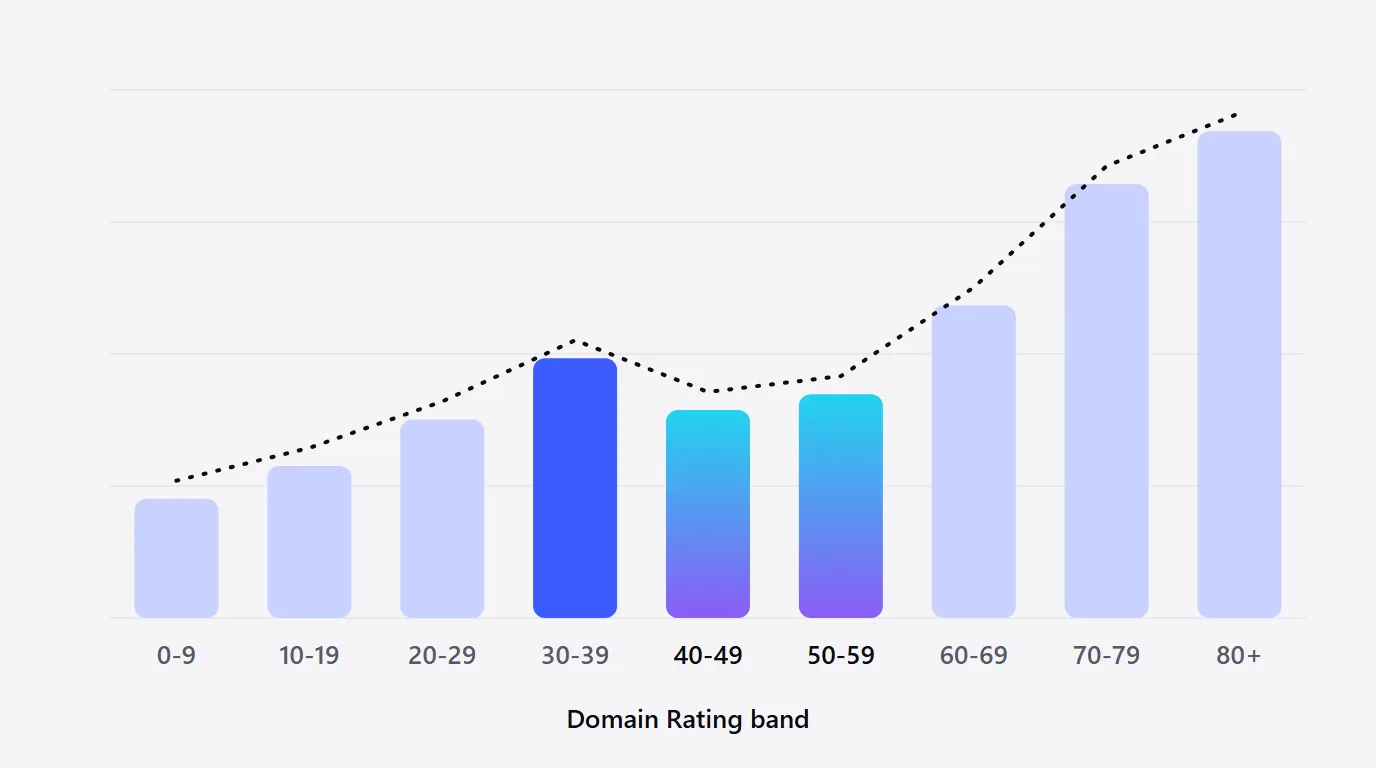
A link insertion averages $179 and a guest post averages $295 bought direct from the publisher, or $461 through a vendor. Those are averages over 62,916 and 257,267 sites in BuzzStream's link building pricing dataset, last updated October 20, 2026. By Domain Rating band an insertion runs $113 to $461.
Domain Rating is Ahrefs' 0 to 100 score for a site's backlink profile strength. Most buyers say "domain authority", which is Moz's equivalent on its own scale. The table below is in DR.
Swipe sideways to see every column →
| DR band | Market average link insertion | Inside the normal spread, up to 1.5x | Ask why above 2x |
|---|---|---|---|
| 0 to 9 | $113 | $170 | $226 |
| 10 to 19 | $144 | $216 | $288 |
| 20 to 29 | $188 | $282 | $376 |
| 30 to 39 | $246 | $369 | $492 |
| 40 to 49 | $197 | $296 | $394 |
| 50 to 59 | $212 | $318 | $424 |
| 60 to 69 | $296 | $444 | $592 |
| 70 to 79 | $411 | $616 | $822 |
| 80 and above | $461 | $692 | $922 |
Read the middle of that second column again. A link insertion on a DR 40 to 49 site costs $49 less on average than one on a DR 30 to 39 site. The DR 50 to 59 average of $212 also sits below the DR 30 to 39 average. The curve sags for two bands. The guest post curve in the same dataset rises in every band, so the anomaly belongs to insertions.
One lesson follows: price is no proxy for quality here. A buyer who reads $246 as a better site than $197 has it backwards. The sagging bands are also where DR is easiest to manufacture.
A 2026 survey of 518 SEO professionals published by Editorial.Link put the average acceptable price for one high quality backlink at $508.95. That came from the 412 respondents who answered the question. It is what professionals said they would accept, not transaction data, and the publisher sells link building.
Ahrefs put the average niche edit asking price at $361.44, from outreach to 450 sites in nine competitive niches, in its study of buying backlinks. Only 12.6% of those sites would sell at all. That is roughly 57 priced quotes behind the number this market repeats, with no year given and no niche named. Read it as what sellers asked when asked directly, never as a market price.
Why does most of the paid link supply fail its own quality bar?
Because sites with real authority and real readers are scarce. Just 120 of the 62,916 sites in that insertion marketplace carry DR 80 or higher, which is 0.19% of the supply. The same dataset places 27,722 sites at 0 to 100 monthly organic visits. That is 65.5% of the 42,339 sites its traffic table covers.
The pass rate figures point the same way, with a caveat that matters. BuzzStream reports that 1.37% of 257,267 guest post opportunities met its own quality standards, roughly 1 in 73. The same page prints about 2% for insertion offers elsewhere, and 0.57% for its own shortlist of 174 qualified sites. Those three rates differ by 3.5x. The page never states the traffic or DR thresholds behind any of them. So treat 1.37% as one vendor's bar on one database, not as a market wide truth.
The 0.19% figure is the sturdier one, because it counts sites rather than judging them. It also explains the pricing at the lowest priced end of this market. A high DR site with almost no search traffic is selling a number rather than an audience. DR measures a backlink profile, and a backlink profile can be built. Our own standard says it plainly: a DR 60 site with almost no search traffic, or a visible link price list, never reaches outreach.
The buyers in that Editorial.Link survey rank the warning signs in the same order. Of 518 professionals, 89.0% named spammy outbound links, 86.3% low quality content, 72.2% poor authority metrics, 67.2% low topical relevance and 63.9% declining organic traffic.
Pace is the other variable, and nobody publishes a defensible figure for it. A burst of paid links in one month looks nothing like the way a growing site accumulates links over a year. Any monthly cap you are quoted is a seller's rule of thumb. Ask whose, and on what evidence.
How do you check a site before you pay for a link on it?
Run four checks on the host site, then put five questions to the seller. The checks are the organic traffic trend, the outbound link ratio, the topical fit and visible spam signals. One failure drops the site whatever its DR. That is the rule a person applies on every prospect under our link quality standards.
Swipe sideways to see every column →
| Check | What passes | How to run it yourself |
|---|---|---|
| Organic traffic trend | Search traffic holding steady or growing, with no sharp lasting drop. | Open the organic traffic chart in Ahrefs Site Explorer or a similar tool. |
| Outbound link ratio | Articles that link out where it helps a reader, not pages crowded with outbound links. | Count the external links in 5 recent articles. |
| Topical fit | A site whose subject relates to your target page. | Read the category list and the last 10 posts. |
| Spam signals | No visible sign the site exists to sell links. | Look for a link price list, a paid posting page or posts on unrelated topics. |
Then the five questions. Which URL is the placement on, and is the link followed or qualified. Do you send the shortlist before any writing starts. Does the publisher list include sites in the country my target page serves. Is this the publisher's price or a reseller's price. What happens if the link is removed, and for how long.
That fourth question has a number behind it. The market markup through a vendor runs about 56%, roughly $166 a post, which turns a $295 direct price into about $461. Part of a high quote is somebody else's margin, not a better site.
The fair price test, run on your own quote
Divide the quote by the market average for that DR band in the table above. Under 1.5x sits inside the normal spread, and above 2x needs a reason you can name. Take a $300 quote on a DR 35 site. The DR 30 to 39 average is $246, so the quote is 1.22x the average. It is 58.9% of the $508.95 those professionals called acceptable, and 3.0x our own DR 30+ niche edit at $99.
The 1.5x and 2x bands come from one dataset. A fair price also says nothing about policy compliance: a perfectly priced paid dofollow link still sits on the wrong side of the line in the policy table above. For a provider by provider comparison, our guide to the best link building services compares seven on published prices and terms.
What we sell, what it costs, and what we say about the risk
Our guest posts sell from $62, niche edits from $59 and packages from $510. DR and Ahrefs traffic are guaranteed at the moment the link goes live, with a replacement for 1 year if a link is lost. Our guest posts and niche edits are paid dofollow placements, so Google's link spam policy covers them exactly as described above.
We state that risk on our service pages in these words. Google's spam policies treat links bought to pass ranking credit as link spam, and a paid niche edit with a followed link falls inside that. Google may ignore such links or take manual action. Our four vetting checks decide which sites we use. They do not move a paid dofollow link to the permitted side of the policy.
On price the honest version runs in both directions. A DR 30+ guest post at $102 is 35.2% of the $290 direct market average for that band, so 64.8% below it. Our DR 50+ niche edit at $279 costs $67 more than the $212 market insertion average for that band. Our DR 60+ niche edit at $379 costs $83 more than the $296 average. We sit under the market on guest posts at every tier, under it on niche edits to DR 40, and over it from DR 50 up. Tier by tier, what we place and what each tier guarantees sits on our high quality backlinks page. The full band by band comparison sits on our link building pricing page.
What the guarantee covers is narrow by design. DR and Ahrefs traffic are guaranteed at the time of delivery, with a 14 day claim window. Both metrics belong to third party tools and can change afterwards. DR 10+ and DR 20+ carry no traffic floor, which starts at DR 30+. A removed link is replaced on a site of the same tier or higher at no extra fee, for 1 year from delivery. We guarantee DR and Ahrefs traffic at delivery and the replacement. We do not guarantee rankings, traffic to your site or AI citations.
What do the alternatives cost per link?
The routes that avoid a paid dofollow link cost $170 to $714 a link at our published prices. The market's own digital PR rates run $714 to $1,667 a link. Bought placements sit lower, from $99 a link. So "do not buy paid dofollow links" is a priced option rather than a slogan, and the table runs lowest cost per link first.
Swipe sideways to see every column →
| Route | Published price | Links | Cost per link |
|---|---|---|---|
| Niche edit, DR 30+, ours | $99 | 1 | $99 |
| Guest post, DR 30+, ours | $102 | 1 | $102 |
| Starter package, ours | $510 | 5 | $102 |
| Journalist links, 5, ours | $849 | 5 | $170 |
| Journalist links, 3, ours | $549 | 3 | $183 |
| Digital PR, Viral Campaign, ours | $8,670 | 20 or more | $433.50 or less |
| Digital PR, National Campaign, ours | $5,610 | 10 or more | $561 or less |
| Digital PR, Starter Campaign, ours | $3,570 | 5 or more | $714 or less |
| Digital PR, market campaign math | $5,000 to $10,000 | 6 to 7 root domains | $714 to $1,667 |
| Digital PR, market rate per link | Quoted per link | 1 | $1,250 to $1,500 |
The last two rows come from one page and disagree with each other. BuzzStream states $1,250 to $1,500 for a unique digital PR link. It then states $5,000 to $10,000 for a campaign that produces 6 to 7 unique linking root domains. That campaign math bottoms out at $714 a link, which is $536 below the floor of its own per link price.
Journalist links and digital PR campaigns differ from a bought placement in what the fee buys. You pay us to pitch. A journalist or editor decides whether to link, and with which attribute. Coverage arrives as a mix of follow and nofollow, which is why these links sit outside the paid dofollow category. Journalist links at $170 to $183 a link carry the lowest cost per link of that kind on the table. They are the first route to suggest to a buyer who does not want the policy exposure.
You already bought links. What do you do now?
If you already bought links, work five steps in order: build the inventory, check follow status and indexation, check Search Console for a manual action, decide keep or remove or disavow on each link, then change the next order. It is the question most buyers arrive with.
- Build the inventory. One row per paid link: live URL, linking domain, anchor, target page, follow status, date live and price paid. Any seller worth using hands this over already. Our own unbranded report carries the live URL, the anchor and the follow status per link. That turns this step into a copy and paste rather than a research project, and agencies pass the same sheet straight to your clients.
- Check follow status and indexation. Open each page and read the link's rel attribute in the page source. A link already marked sponsored or nofollow carries no policy exposure. Then check whether the host page sits in Google's index at all, because an unindexed host page passes nothing either way.
- Check Search Console. Open the Manual actions report on the property. A clean report means no human reviewer has acted. That is the only enforcement signal Google gives you directly, and its absence is no proof the links are counting.
- Decide per link. Keep a link on a relevant site with real traffic. Ask the publisher to add rel="sponsored", or to remove the link, where the placement is weak. Disavow only the links you cannot get removed and would not have bought, because the file tells Google to ignore them rather than erasing the purchase.
- Change the next order. Fix the input that produced the bad links: the four checks above, the price test, and the five seller questions. Repeating the same order with a different vendor repeats the result.
Work the inventory in one sitting rather than link by link over months. The decision costs less time when every row sits on the same sheet.
Should you be buying backlinks?
Buy a paid dofollow link only when you accept that Google's policy covers it, and you can afford to lose the ranking it buys. That is the verdict on buying backlinks, and it is a commercial judgment rather than a technical one. Five conditions decide it, and all five hold or the answer is no.
- The target page already competes. A page ranking in positions 4 to 20 moves on added authority. A page outside the top 50 usually has a content or intent problem that links do not fix.
- The loss is survivable. Model the revenue of that page falling back to where it started. A business that cannot take that outcome does not carry the exposure.
- The host sites pass the four checks. Traffic trend, outbound link ratio, topical fit and spam signals, on every site, with the shortlist in front of you before anyone writes.
- The price survives the test. Under 1.5x the market average for that DR band, with the reseller markup accounted for.
- Something else is also running. Journalist links, digital PR or content that earns links on its own, so the whole ranking does not rest on placements the policy names.
Fail the second condition and the answer is no at any price. Fail the first and the money belongs in the page itself. Where all five hold, run the four checks on the shortlist yourself, then order the smallest batch that proves the vetting works.
Frequently asked questions
Should you buy backlinks if your competitors are doing it?
A competitor's exposure does not reduce yours. Google's policy applies per site, and nobody publishes enforcement rates, so a rival ranking today proves nothing about next quarter. Decide on your own tolerance. Ask how much of that page's revenue you can lose, and whether the host sites pass the four vetting checks on their own merits.
Do nofollow and sponsored paid links do anything for SEO?
They pass no ranking credit, which is the point of the attribute. What they still do is put your brand in front of a publisher's readers, and leave a citation an answer engine can read. Treat a sponsored placement as advertising with a measurable audience, priced against that audience, not as a ranking purchase.
Can Google tell the difference between a bought link and an earned one?
Google states it detects policy violations with automated systems plus human review as needed, and it publishes no detection rate. The patterns a reviewer can see are visible to anyone. A public link price list, optimized anchors in placed articles, and a link profile that grew in bursts all read as paid.
What is a fair price for one backlink?
Divide the quote by the market average for that site's DR band. BuzzStream's October 2026 dataset puts insertion averages at $113 for DR 0 to 9 and $461 for DR 80 and above, across 62,916 sites. Under 1.5x sits in the normal spread. A vendor markup of about 56% explains quotes above it.
What happens to our links if we stop paying?
Guest posts and niche edits are bought per placement, with no contract and no recurring fee, so a link stays live when you stop ordering. A link removed within 1 year of delivery is replaced on a site of the same tier or higher at no extra fee. Our refund policy sets out the claim steps.